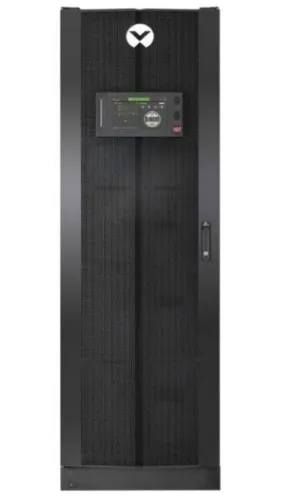

Choosing an EXL S1 configuration requires more than matching a facility’s connected load to a kVA label. You will be able to calculate usable capacity, assess transformer-free operation, compare room and redundancy requirements, and prepare a specification that a Bengaluru dealer can verify against the site.
Key takeaways
- Size the UPS from simultaneous kW, kVA, growth and post-failure reserve.
- Confirm transformer-free double conversion suits the facility’s voltage and fault-isolation requirements.
- Require ratings, overload limits, bypass paths, battery autonomy and test conditions in the quotation.
- Specify redundancy, maintenance access and Bengaluru service responsibilities before ordering.
Which EXL S1 rating matches the facility’s real load?
Choose the rating from the highest simultaneous kW and kVA demand, then add starting-current headroom, growth and the reserve required after a failure. At unity power factor, an EXL S1 300 kVA supplies about 300 kW; the usable figure falls when power factor is below 1.0.
| Rating | Approximate output at unity power factor | Selection check |
|---|---|---|
| 300 kVA | 300 kW | Measured peak load plus reserve stays below 300 kW |
| 500 kVA | 500 kW | Allows moderate expansion or motor-starting margin |
| 800 kVA | 800 kW | Suits larger process, IT or mixed industrial loads |
| 1000 kVA | 1000 kW | Provides substantial growth and redundancy planning room |
| 1200 kVA | 1200 kW | Fits very large blocks, but test the single-unit failure consequence |
Do not treat those figures as automatic capacity. Motors, transformers, compressors and high-inrush rectifiers can exceed running demand during starting; verify the UPS overload curve and crest-factor rating. Calculate kVA as kW divided by power factor, then leave capacity for planned growth, battery recharge and the required reserve.
For a generator-backed site, match the chosen frame to the generator’s permissible input power factor, input-current distortion, step-load response and recharge limit. Compare N+1 or 2N capacity separately: an EXL S1 1200 kVA unit can meet the load yet remain a single point of failure.
Confirm the exact voltage, parallel configuration and battery autonomy test in the quotation.
How does transformer-free double conversion work?
A transformer-free online UPS uses double conversion: incoming AC becomes DC in the rectifier, then returns to regulated AC through the inverter. The load therefore receives power from the inverter rather than directly from a fluctuating utility or generator supply.
The rectifier controls the DC link and charges the battery system through its charging circuit. During an outage, the battery string feeds the DC link without an interruption, allowing the inverter to continue supplying the load. Battery voltage, string count, protection and autonomy must match the confirmed UPS configuration.
The static bypass provides an alternate utility path around the power-conversion stage. It transfers the load when the inverter is overloaded, faulted or taken offline, but only when voltage, frequency and phase are acceptable; bypass fault capacity and downstream breaker discrimination require separate verification.
Before approving a transformer-free online UPS, confirm:
- A single-line diagram showing rectifier, inverter, battery string, static bypass and maintenance bypass.
- Neutral bonding, earthing and bypass-neutral continuity, because the UPS transformer does not provide these automatically.
- An isolation transformer where the facility needs galvanic separation, a separately derived neutral, different input and output voltages, or specific earth-fault behaviour.
- The added transformer’s footprint, heat, impedance, losses and short-circuit effects in the protection study.
What space and architecture advantages matter at large scale?
At large scale, compare the whole room, not just the UPS cabinet. A transformer-free online UPS such as EXL S1 1200 kVA can reduce equipment volume and weight, but batteries, switchgear, bypass panels, cable bends and service clearances still govern the architecture.
| Architecture | Room and access effect | Main check |
|---|---|---|
| EXL S1 transformer-free online UPS | Smaller UPS section and lower floor loading than a transformer-based arrangement; retain battery, bypass and cable-access zones. | Confirm heat rejection, neutral continuity, earthing, fault protection and manufacturer service clearances. |
| Transformer-based UPS | Transformer adds footprint, weight, heat and lifting requirements, often enlarging the room. | Allow transformer ventilation, acoustic separation, cable radius and maintenance access. |
| Modular UPS | Power modules can fit a compact frame and permit staged capacity. | Reserve module withdrawal space, battery cabinets, bypass access and expansion clearance. |
| Multiple smaller UPS units | Several cabinets create duplicated cable entries, bypasses, switchgear and service aisles. | Check parallel controls, fault selectivity, battery segregation and access to every unit. |
| Generator-only backup | Removes the UPS room but cannot cover generator start time, transfer interruption or voltage disturbances. | Provide generator, fuel, synchronising and distribution space; batteries do not replace ride-through. |
Obtain a scaled layout showing doors, cable trenches, battery replacement paths, floor loading and front, rear and side clearances. Compare the installed single-line design, not cabinet dimensions alone.
Which technical specifications must appear in the quotation?
A usable quotation for an exl s1 300 kva installation must state operating limits, test conditions and fault behaviour—not just the kVA rating. Require the following entries:
| Item | Specify | Why it matters |
|---|---|---|
| Operating modes | Double conversion, battery, static bypass and economy mode | Economy operation changes conditioning and transfer behaviour |
| Efficiency | Double-conversion efficiency at 25%, 50%, 75% and 100% load | Reveals losses across the facility’s real load range |
| Power quality | Input power factor, output power factor, input current THDi and output voltage THD | Determines generator loading and sensitive-load compatibility |
| Overload | Exact percentage and duration in inverter and bypass modes | Confirms ride-through for starting or temporary surges |
| Fault capacity | Inverter current limit, bypass short-circuit rating and withstand time | Separates UPS protection from transformer prospective fault current |
| Transfer | Static-bypass synchronisation, transfer time, return-to-inverter logic and maintenance-bypass interlocks | Prevents an interruption or unsafe switching sequence |
For a generator-backed site, request step-load response, permissible generator input power factor, recharge power limit and harmonic-performance data. Ask for breaker-discrimination results in inverter, battery and bypass modes; electronic current limiting does not replace bypass fault capacity. The continuous rating, neutral arrangement and short-circuit withstand of the maintenance bypass must match the switchboard.
How should redundancy, batteries and bypass paths be designed?
At 1,200 kVA, one UPS cabinet remains a single point of failure even if its internal modules are N+1. Size N as the capacity required by the protected load, then add one complete parallel unit of equal rating; confirm that losing one unit still supports kW, kVA, overload and battery-recharge demand.
Use 2N when maintenance or a single distribution fault cannot interrupt the load. Build two electrically independent UPS systems, batteries, switchboards and downstream paths, with no shared bypass panel or battery breaker that defeats the separation.
- Connect dual-cord servers, controls and medical equipment to separate A and B buses. Route each bus through independent breakers, cables and maintenance bypasses.
- Give every parallel UPS unit its own input protection, output isolation and battery disconnect. A common battery bank saves space but creates a shared failure point; separate strings preserve unit independence.
- Specify a wrap-around maintenance bypass with mechanical and electrical interlocks, fault-current rating and isolation of the UPS before servicing. Demonstrate discrimination in inverter, battery and bypass modes.
- Feed single-cord manufacturing controls or hospital devices through a rated static transfer switch or automatic transfer switch supplied by A and B; do not plug both inputs into one bus.
The same checks apply to an EXL S1 1200 kVA design: test the loss-of-one-unit, battery-string and bypass scenarios before approval.
What should a Bengaluru project specification require?
Require a signed, site-specific design rather than a cabinet quotation. Shortlist industrial online UPS dealers in Bengaluru for EXL S1 large facilities that will verify the 415 V, 50 Hz distribution, generator neutral, earthing and bonding scheme, prospective fault level, cable routes, floor loading, ventilation and room temperature.
Ask the tender to include:
- A single-line diagram showing input, output, static bypass, maintenance bypass, neutral continuity, isolation-transformer requirements and downstream breaker coordination.
- Demonstrated discrimination in inverter, bypass and battery modes, distinguishing UPS current limiting from the facility’s prospective short-circuit current.
- Battery chemistry, string count, DC protection, rack or cabinet footprint, real kW load, end-of-discharge voltage, ageing margin, recharge time and the witnessed autonomy-test method.
- Compliance declarations and test evidence to IEC 62040-1, IEC 62040-2 and IEC 62040-3.
- FAT and SAT procedures, commissioning responsibilities, acceptance records, remote monitoring, response-time SLA, critical spares and a battery-replacement plan.
Originate Power Solutions should present these items as one installed-solution scope, so you can compare integration risk and lifecycle support instead of only the EXL S1 purchase price.
Related product
 | Three Phase UPS Vertiv™ Liebert® EXL S1 UPS (300-1200 kVA/kW) - Transformer-Free Design The Vertiv™ Liebert® EXL S1 is a monolithic, transformer-free UPS that features industry-leading footprint and power per square foot. View product → |
Frequently asked questions
How do you choose the right EXL S1 rating for a large facility?
Use the highest simultaneous kW and kVA demand, then add starting-current headroom, planned growth and the reserve needed after a module failure. At unity power factor, an EXL S1 300 kVA supplies about 300 kW; the usable kW falls below that when power factor is less than 1.0.
What does transformer-free double conversion mean in an EXL S1 UPS?
The rectifier converts incoming AC to DC and the inverter rebuilds a regulated AC output continuously. A transformer-free design reduces weight and floor area, but the quotation must state input and output voltage, isolation arrangements, harmonic performance and bypass behaviour.
Which specifications should an EXL S1 quotation include?
Require rated kVA and kW, input and output voltage, frequency range, power factor, efficiency, overload duration, short-circuit capability, battery autonomy and recharge time. Also request dimensions, weight, heat dissipation, noise, IP rating, communication interfaces and test conditions.
How should redundancy, batteries and bypass paths be specified?
State whether the system uses N, N+1 or another capacity arrangement, and define the load remaining after one module fails. Specify battery chemistry, autonomy at the actual load, end-of-discharge voltage, recharge time, battery-room conditions, static bypass, maintenance bypass and transfer limits.