
A 30–600 kW headline range does not tell you which APM2 configuration will protect your load, preserve N+1 capacity, or leave room for growth. Compare module counts, cabinet limits, electrical specifications, bypass design, efficiency at your actual load and battery assumptions before treating two quotations as equivalent.
Key takeaways
- Treat 30–600 kW as a configurable range, not one continuously adjustable UPS.
- Compare installed module size, bypass capacity, efficiency and battery runtime.
- Size for present load, planned growth and the redundancy level your equipment needs.
- Require load-bank results, transfer tests and documented battery runtime in the quotation.
What do the APM2 kilowatt options mean in a real installation?
The published 30–600 kW range describes configurable systems, not one UPS whose rating turns continuously from 30 to 600 kW. The actual size depends on installed 30 kW or 50 kW power modules, cabinet limits and the bypass design.
Treat only rows confirmed in current Vertiv documentation as purchasable options. This table shows the configuration arithmetic to request in an APM2 kilowatt comparison.
| Nominal system rating | Module combination | Installed modules | Cabinet or frame requirement | Total installed capacity | N+1 usable capacity | Bypass arrangement | Capacity source |
|---|---|---|---|---|---|---|---|
| 30 kW | 1 × 30 kW | 1 | Confirm frame limit | 30 kW | 0 kW after one-module loss | Confirm common or separate bypass | One power module |
| 60 kW | 2 × 30 kW | 2 | Confirm frame limit | 60 kW | 30 kW | Confirm bypass rating and source | Multiple power modules |
| 200 kW | 4 × 50 kW | 4 | Confirm cabinet limit | 200 kW | 150 kW | Confirm common or separate bypass | Multiple power modules |
| 250 kW | 5 × 50 kW | 5 | Confirm cabinet limit | 250 kW | 200 kW | Confirm bypass configuration | Multiple power modules |
| 300 kW | 6 × 50 kW | 6 | Confirm cabinet limit | 300 kW | 250 kW | Confirm bypass configuration | Multiple power modules |
Six 50 kW modules therefore provide 300 kW installed, but only 250 kW under a one-module-loss N+1 rule. A smaller system lowers initial cost but leaves less physical capacity; a larger system adds expansion headroom and lower loading, yet poor low-load efficiency is possible.
Before publication or purchase, ask Vertiv to verify every rating, module increment, cabinet limit and bypass arrangement. This is essential when comparing UPS systems traders in Pune APM2 kilowatt comparison quotations.
Which electrical and conversion specifications should you compare?
Do not compare “IGBT” as though it were a complete UPS specification. IGBT means insulated-gate bipolar transistor; IGBTs may be used in the rectifier, inverter, or both. An IGBT online UPS comparison for traders in Pune must identify the entire conversion path and guaranteed operating limits.
| Operating mode | Conversion path | Buyer consequence |
|---|---|---|
| Continuous double conversion | AC becomes DC, then regulated AC through the inverter | Protects sensitive loads from input voltage and frequency disturbances |
| ECO or bypass | Load receives bypass supply while conversion is reduced or avoided | Efficiency may improve, but regulation and transfer performance must be verified |
Require the quotation to state:
- Input and output voltage, frequency, three-phase configuration, three-wire or four-wire arrangement, and neutral requirement.
- Input and output power factor, permissible voltage and frequency windows, overload limits, short-circuit performance, bypass rating, and common-input or separate-input wiring.
- Guaranteed input power factor and THDi at 25%, 50%, 75% and 100% load, with the input-filter condition stated for every result.
- Generator operation data, including the filter arrangement, because high input power factor does not prove low THDi or generator compatibility.
Do not accept an APM2 figure unless the manufacturer confirms it in writing. Compare output kW and kVA, allowable load power factor, normal-mode efficiency, bypass transfer behaviour, and the stated IGBT arrangement; an ECO efficiency claim cannot substitute for continuous double-conversion performance.
How should you compare APM2 with APM2 Plus?
Both APM2 and APM2 Plus are published in the 30–600 kW class with modular, three-phase architecture. Treat that as the shared baseline, not proof that their internal modules, controls or service requirements are identical.
| Comparison point | What to verify from Vertiv documentation |
|---|---|
| Power modules and controls | Module rating, control platform, paralleling method and replacement procedure |
| Efficiency and modes | Curves for normal double-conversion, ECO and bypass operation |
| Redundancy | Maximum modules, allowable failure units and post-failure output |
| Batteries and communications | Battery types, charging limits, monitoring protocols and network interfaces |
| Cabinet and service | Dimensions, weight, clearances, module withdrawal and maintenance steps |
A claim of “up to 97%” does not prove 97% efficiency at every load, in normal double-conversion mode or in ECO mode. Request measured curves at your expected 20%, 30%, 50%, 75% and 100% load points, including module-sleep behaviour.
Your priority changes the evidence you need: efficiency-focused buyers need verified normal-mode and low-load data; expansion-focused buyers need module and cabinet capacity; redundancy-focused buyers need failure-unit calculations; initial-cost-focused buyers need a like-for-like scope.
UPS systems traders in Pune comparing APM2 UPS options should not call either model superior until Vertiv documentation confirms the difference. Price comparisons are invalid if one quotation includes batteries, bypass equipment, communications or service work that the other excludes.
How do you size an APM2 for load, growth, redundancy and runtime?
Measure the live load in kW before selecting an APM2. Do not size from equipment nameplates. For a double-conversion online UPS, add forecast growth, startup or inrush demand the UPS must carry, battery-charging load, and the selected redundancy policy.
- Record present real power, peak demand, power factor and load profile.
- Add forecast growth to obtain planned operating capacity.
- Compare that capacity with total installed capacity and capacity after the defined failure unit is removed.
- State input and output kW, kVA, manufacturer kW/kVA relationship and allowable load power-factor range.
kW is real power; kVA is apparent power. A kVA-only comparison is unsafe because the manufacturer’s relationship between kW and kVA determines usable capacity.
| Configuration | Installed capacity | Capacity after one-module loss | Result |
|---|---|---|---|
| Six 50 kW modules | 300 kW | 250 kW | N+1 arrangement |
| Nominal 200 kW system | 200 kW | Not enough margin | No N+1 growth margin |
| Required example load | 180 kW + 20% growth = 216 kW | 216 kW required | Six modules pass the stated criterion |
For an IGBT online UPS traders in Pune APM2 comparison, and any double conversion online UPS traders in Pune APM2 sizing exercise, calculate runtime separately. Specify minutes, end-of-discharge voltage, ageing allowance, battery temperature, battery model, DC configuration and recharge time.
Never infer autonomy from UPS kW; a quotation stating only “10 minutes at 200 kW” is not reproducible.
What should a Pune quotation and acceptance test prove?
A valid quotation must prove what will work at your site, not merely state an APM2 kW rating. Require present and forecast kW, measured power factor, module count, N+1 definition, battery ageing margin, autonomy, common or separate bypass sources, maintenance bypass, breaker selectivity, neutral arrangement, generator compatibility, ambient temperature, altitude, ventilation and battery-room temperature.
- Check Pune’s actual conditions: heat, altitude, restricted ventilation and battery-room temperature can derate capacity or shorten battery life. Generator short-circuit strength also affects rectifier behaviour and nuisance-trip risk.
- Use this checklist for a UPS systems traders in Pune APM2 kilowatt comparison and for double conversion online UPS traders in Pune APM2 sizing.
| Item | Site proof to require |
|---|---|
| Efficiency and regulation | Demonstrate steady-state efficiency at expected loads, output voltage regulation and frequency regulation. |
| Transfer behaviour | Test static-bypass transfer and return, including synchronisation and interruption. |
| Fault and overload response | Demonstrate overload operation, alarms and downstream fault selectivity with the installed breakers. |
| Redundancy and batteries | Withdraw one module under the stated N+1 condition, then show battery discharge performance against autonomy and ageing assumptions. |
Factory certificates do not prove site N+1 behaviour. Record test readings, alarm logs, breaker settings and the load-bank or live-load conditions in the acceptance document.
Compare complete scopes and service-response assumptions, not price per kW. Originate Power Solutions can sit alongside other local suppliers only when every quotation documents these same fields.
Related products
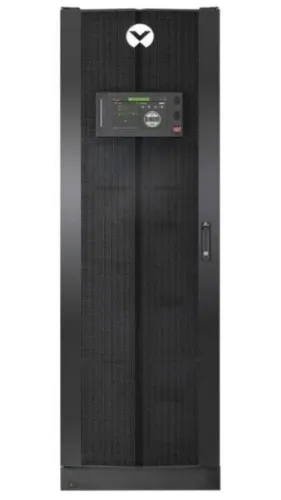
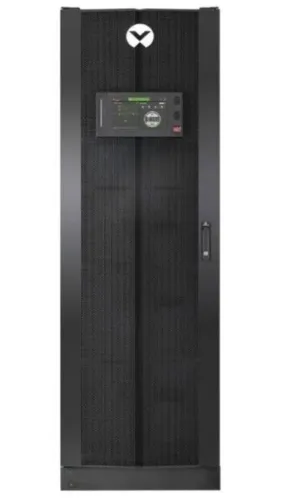
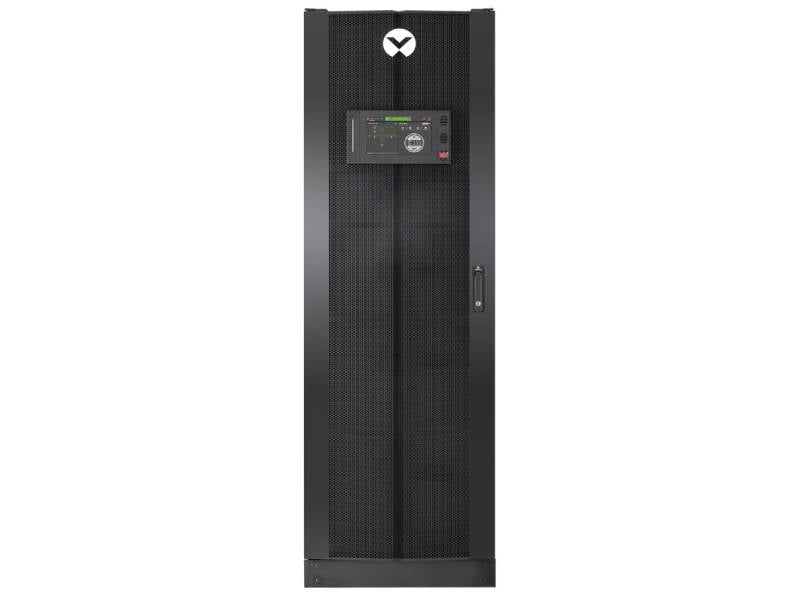 | Three Phase UPS Vertiv™ Liebert® APM2 UPS (30-600 kW) Introducing a next-generation modular and transformer-less UPS design, Vertiv™ Liebert® APM2, a feature-rich high-power density UPS that brings... View product → |
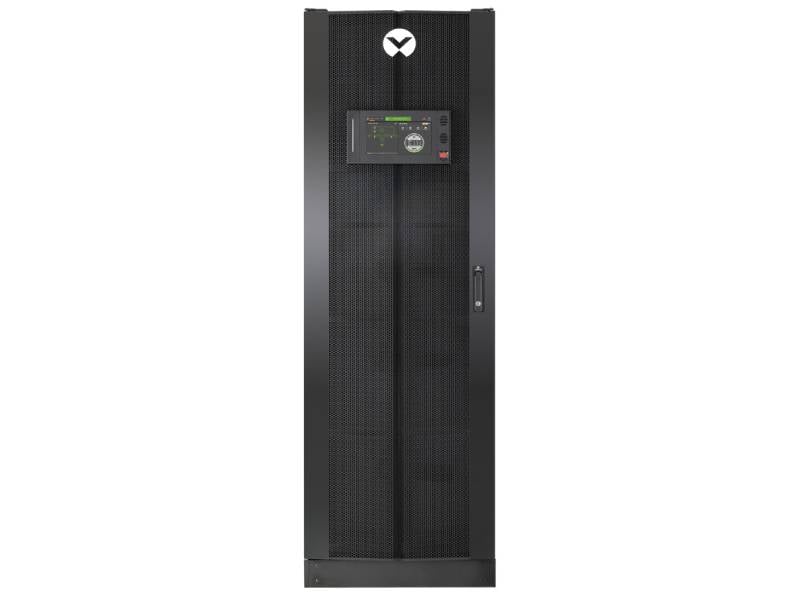 | Three Phase UPS Vertiv™ Liebert® APM2 Plus UPS (30-600 kW) Introducing the all-new Liebert® APM Plus, a scalable, high-density, transformer-free UPS that delivers double conversion efficiency up to 97%, as... View product → |
Frequently asked questions
What do the Vertiv Liebert APM2 kilowatt options mean in an installation?
The 30–600 kW range describes configurable systems assembled from 30 kW or 50 kW power modules. The cabinet limit and bypass design determine the usable system rating.
Which APM2 electrical and conversion specifications should you compare?
Compare input and output voltage, frequency, phase configuration, power factor, total harmonic distortion, efficiency, overload performance, battery arrangement and static-bypass rating.
How should you compare APM2 with APM2 Plus?
Request matching datasheets for module rating, cabinet capacity, efficiency curve, bypass rating, battery compatibility, controls, communications, service clearances and available redundancy. Compare both systems at your actual load, not only at their maximum rating.
How do you size an APM2 for load, growth, redundancy and runtime?
Measure real kW and kVA, add a documented growth allowance, then reserve capacity for the required N+1 or other redundancy plan. Select batteries from the required load, runtime, end voltage, temperature and recharge time.
What should a Pune APM2 quotation and acceptance test prove?
The quotation should identify modules, cabinet rating, bypass, batteries, installation scope, warranty and test criteria. Acceptance testing should record load-bank output, transfer behaviour, alarms, bypass operation, battery runtime and recharge performance.