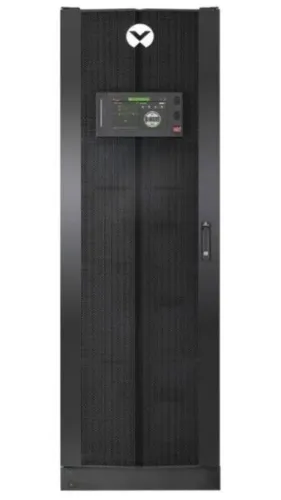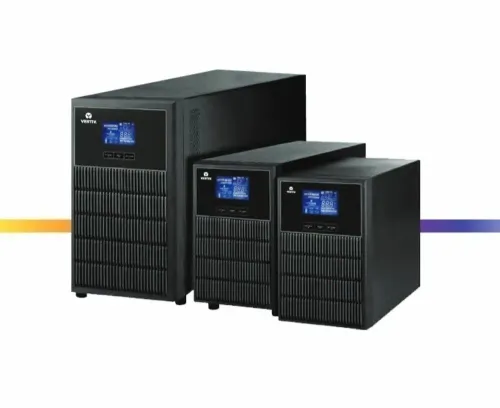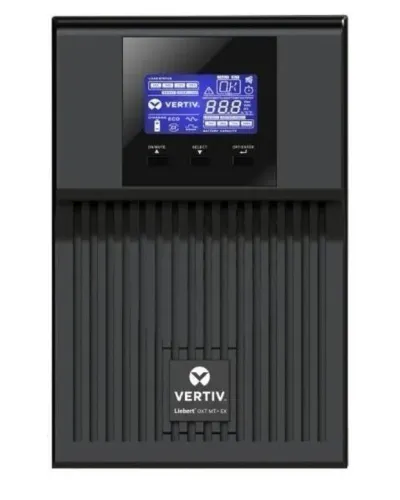

Choosing a three-phase UPS in Mumbai requires more than matching a kVA number to a load. You need to compare power-conversion behavior, transformer and battery design, installation constraints, redundancy, operating losses, and the service support available for the exact model. By the end, you will have a practical method for deciding whether a Vertiv Liebert HiPulse configuration fits your site better than a transformerless or modular alternative.
Key takeaways
- Double conversion isolates critical loads from voltage dips, swells and frequency changes.
- Compare transformerless and modular UPS designs against fault tolerance, footprint and service requirements.
- Size for real load, inrush current, growth and battery autonomy—not nameplate kVA alone.
- Check Mumbai service coverage, battery support, spares and commissioning before choosing a distributor.
How double conversion protects the load during Mumbai power disturbances
A double-conversion online UPS does not wait for utility power to fail. Its rectifier converts incoming AC to DC, and its inverter continuously rebuilds AC for the load. The equipment therefore avoids direct exposure to voltage dips, swells, frequency variation and input harmonics.
During an outage, the battery supplies the DC bus while the inverter keeps operating. The load does not transfer from a standby inverter, so sensitive servers, medical equipment and industrial controls avoid the interruption associated with offline or line-interactive designs.
That continuity matters when even a brief break can reboot a controller, corrupt data or stop a production process.
Mumbai sites also need to examine the UPS input, not only its output. A selected HiPulse model with high input power factor and low input-current THD places less reactive and harmonic burden on a generator than an older six-pulse rectifier design. Generator selection still requires a transient, short-circuit and nonlinear-load study.
Eco or high-efficiency mode is different: it can place the load on bypass and expose it to bypass voltage and frequency conditions. Ask a double-conversion online UPS distributor in Mumbai to state transfer time, bypass limits and synchronization criteria in writing.
Those checks explain the practical HiPulse online UPS benefits without treating bypass power as conditioned inverter power.
HiPulse versus transformerless and modular three-phase UPS designs
A transformer-based HiPulse is the better choice when galvanic isolation, fault tolerance, or difficult site conditions matter more than minimum footprint and peak efficiency. The transformer separates the inverter output from upstream disturbances and helps manage neutral, earth-reference, and certain nonlinear-load problems.
Confirm the selected model’s input power factor, input-current THD, and generator compatibility rather than assuming every HiPulse installation performs alike.
| Option | Main advantage | Trade-off |
|---|---|---|
| HiPulse transformer-based | Isolation, robust output, familiar service architecture | More floor space, weight, heat, and transformer losses |
| Liebert ITA2 transformerless | Compact cabinet, lower heat output, high efficiency | Less isolation; check neutral, bypass, and fault-current requirements |
| Liebert APM2 modular | Capacity can track growth; modules support redundancy | More controls, modules, and service interfaces to maintain |
| Other transformerless UPS | Lower footprint and operating losses | Performance depends on input/output power factor, filters, and load compatibility |
Choose ITA2 or APM2 when floor loading, room size, energy losses, and incremental capacity dominate the decision. Choose HiPulse for a generator-backed plant, sensitive industrial process, long cable runs, or a load whose neutral and fault behaviour demands isolation; validate this through a site study.
Compare all options using identical kW, crest factor, voltage, bypass source, autonomy, temperature, battery chemistry, redundancy, efficiency test point, and tariff. A double conversion three phase UPS distributor should also provide model-specific IEC 62040-1, IEC 62040-2, and IEC 62040-3 evidence.
For a vertiv liebert hipulse ups in mumbai, insist on service access around the transformer, fans, control boards, and bypass panel.
How to size the UPS beyond its nameplate kVA
A 100 kVA rating does not automatically support 100 kW of critical equipment. Size a Vertiv Liebert HiPulse UPS in Mumbai against real power, operating conditions and the failure you need the system to survive.
1. Record the present and planned load in kW, not only kVA. Divide kW by the UPS output power factor to calculate required kVA, then add growth. A 0.9 power-factor UPS rated at 100 kVA delivers less usable real power than a 1.0 power-factor unit.
2. Measure peak demand and load behaviour. Include server power supplies, variable-speed drives, motors, compressors and other nonlinear loads. Check crest factor, starting current, permitted overload duration and manufacturer derating; a steady average reading can hide a trip during motor starting.
3. State the operating target. For a 30 kVA to 500 kVA HiPulse rating, specify the calculated running kW, future kW, battery-charger demand, bypass rating and required autonomy. Require the battery quotation to state runtime at a named load and end-of-discharge voltage, not merely the cabinet size.
4. Design redundancy mathematically. Under N+1, remove the largest UPS unit or module and confirm that the remaining capacity supports the critical load plus growth margin. Confirm parallel controls, maintenance bypass and bypass-source capacity; a product label alone does not create redundancy.
5. Compare every shortlisted system at identical load, efficiency test point, ambient temperature, battery chemistry, autonomy and tariff. High input power factor and low input-current THD are useful HiPulse online UPS benefits, but generator transient and nonlinear-load studies still decide compatibility.
Battery runtime, efficiency and site conditions that change the comparison
A fair total-cost comparison starts with identical assumptions: present and future kW, crest factor, input voltage and frequency, bypass source, autonomy, ambient temperature, battery chemistry, redundancy, efficiency test point and electricity tariff. Nameplate kVA alone can favour a unit that later costs more in losses, battery replacement or downtime.
HiPulse online UPS benefits become meaningful only against another model on this same load profile.
| Option | Efficiency and heat | Installation trade-off |
|---|---|---|
| Transformer-based UPS | Transformer losses add heat and energy cost, especially at light load | Greater mass and floor loading; confirm service access |
| Transformerless UPS | Lower losses and smaller footprint can reduce cooling demand | Check fault-current behaviour, power factor, cable sizing and bypass coordination |
Longer autonomy means more battery strings or cabinets, larger protective devices, greater floor loading and more ventilation demand. Battery chemistry changes charging behaviour, replacement planning and temperature tolerance; operating above the battery manufacturer’s reference temperature accelerates capacity loss and replacement cost.
Use these site checks before ranking models:
- Measure maximum ambient temperature, humidity, altitude, dust exposure and available ventilation.
- Verify UPS and battery-cabinet floor loading, cable-entry direction, service clearances and battery-room ventilation.
- Compare efficiency at your actual load, not only the published peak figure; losses become cooling load.
- Ask a double conversion three phase UPS distributor to state the battery runtime at the specified kW, temperature, chemistry and end voltage. Include generator transients and recharge load in the comparison.
The Mumbai procurement and service checks that decide the real outcome
Do not approve a quotation until the distributor proves who will install, test and support the equipment after commissioning. A double conversion online UPS distributor in Mumbai must provide model-specific documents, named service contacts and a written boundary of responsibility.
1. Confirm authorization for the quoted UPS model and request the factory warranty, exclusions, battery warranty and escalation route. Check that the compliance file identifies the exact model under IEC 62040-1, IEC 62040-2 and IEC 62040-3.
2. Require a site survey covering input voltage and frequency, bypass source, fault level, earthing, cable routes, floor loading, ambient temperature and generator capacity. For a 3/1 or 3/3 design, make the distributor show how the bypass and downstream distribution will operate.
3. Demand one comparison sheet for every competing unit using identical present and future kW, crest factor, autonomy, redundancy, battery chemistry, efficiency test point and electricity tariff. Nameplate kVA and purchase price alone hide losses and replacement costs.
4. Get a commissioning method statement and acceptance-test record covering transfer to bypass, battery discharge, alarms, load-bank performance and generator interaction. High input power factor and low input-current THD help, but require a generator transient, short-circuit and nonlinear-load study.
5. Put response times, preventive-maintenance visits, spare control boards and fans, battery replacement, remote monitoring and emergency labour in the contract. Define whether the provider owns the UPS, batteries, bypass panel and generator interfaces.
Originate Power Solutions should be asked to document these deliverables when quoting a Vertiv Liebert HiPulse UPS in Mumbai, just as any competing supplier should.
Related product
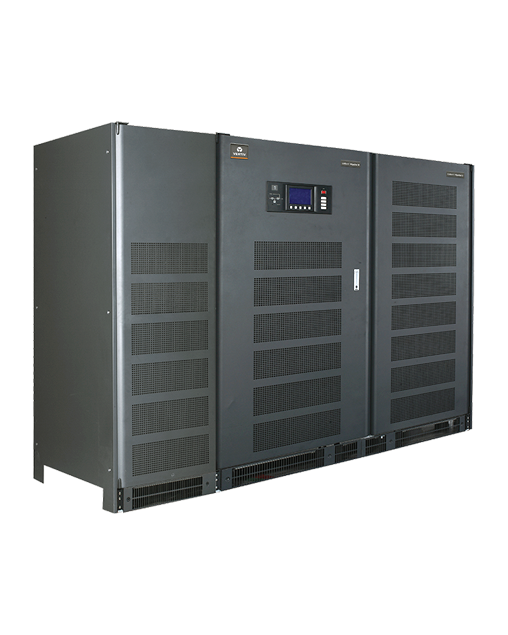 | Three Phase UPS Vertiv Liebert HIPULSE-U 30kVA - 500kVA Online UPS with Inbuilt Isolation Transformer ₹450000 The Vertiv Liebert Hipulse-U offers a reliable, scalable, and user-friendly solution to ensure availability of various critical applications. View product → |
Frequently asked questions
How does a double-conversion online UPS protect equipment during Mumbai power disturbances?
Its rectifier converts incoming AC to DC while the inverter continuously rebuilds clean AC, isolating loads from voltage dips, swells, frequency variation and input harmonics.
How does Vertiv Liebert HiPulse compare with transformerless three-phase UPS systems?
Compare isolation, efficiency, footprint, input power quality, fault tolerance and the operating conditions at your site rather than comparing kVA alone.
Is a modular three-phase UPS always better than a HiPulse system?
No. Modular systems can simplify capacity expansion and module replacement, while a fixed-frame system may suit facilities that prioritise a proven architecture, available floor space and a defined load.
How should you size a three-phase online UPS beyond its nameplate kVA?
Calculate actual kW and power factor, add expected load growth, check inrush and nonlinear loads, and specify the required battery runtime and redundancy.
Which site conditions affect UPS efficiency and battery runtime in Mumbai?
Ambient temperature, ventilation, humidity, dust, battery age, load level, charging settings and the required autonomy all affect performance and runtime.