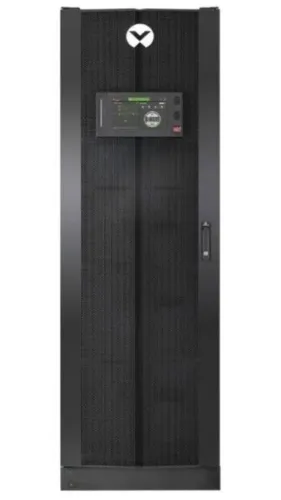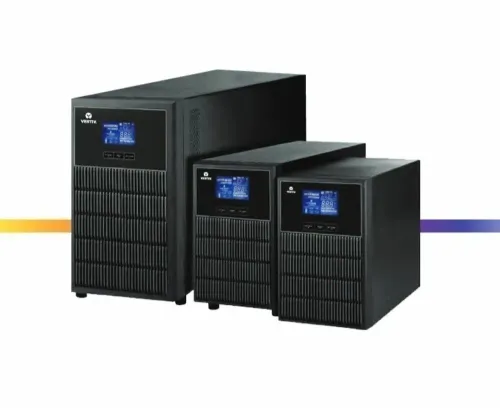

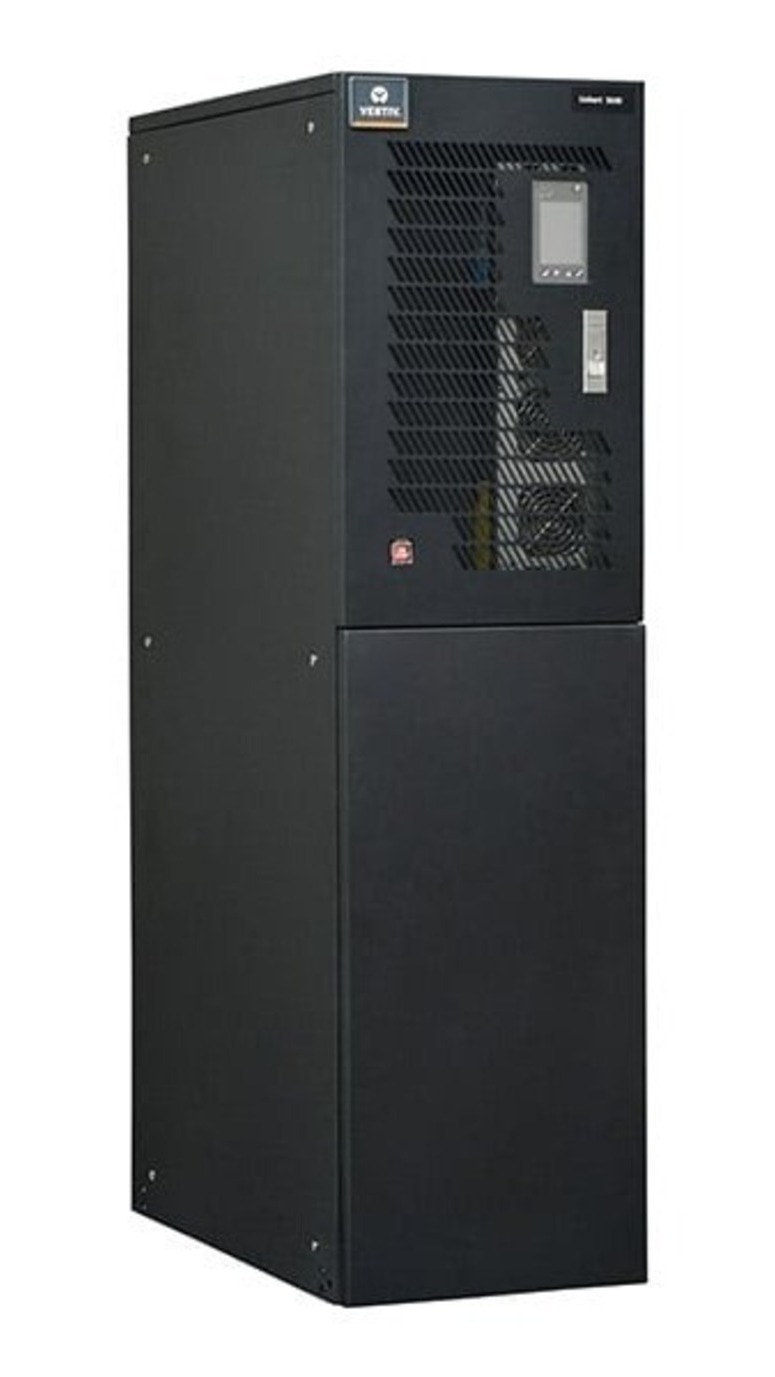
Choosing a 60–200 kVA UPS requires more than matching a number to your connected load. You will be able to identify the correct MTP rating, test a Pune dealer’s technical offer, and compare installation, battery, bypass, commissioning and service terms before you request a quotation.
Key takeaways
- Convert kVA to usable kW before comparing MTP UPS quotes.
- Match transformer-free topology with your site’s three-phase electrical system.
- Get batteries, room conditions, installation and testing listed in writing.
- Verify dealer authority, local stock and post-commissioning service coverage.
Confirm the MTP rating, model and usable power before comparing dealers
At a 0.9 output power factor, 60 kVA provides about 54 kW, while 200 kVA provides about 180 kW. Vertiv Liebert MTP is a transformer-free, online double-conversion, three-phase UPS family commonly specified at 60, 80, 100, 120, 160 and 200 kVA.
A quotation for a Vertiv Liebert MTP UPS in Pune must state the exact model code, not merely “MTP 60–200 kVA.”
Before comparing prices, add:
- Measured kW and kVA demand, motor-starting current, rectifiers, variable-speed drives, phase imbalance and battery-recharge demand.
- Planned expansion, crest factor, bypass capacity and the generator’s available capacity.
Choose N+1 parallel units when one unit can fail without dropping the protected load. Choose modular expansion when capacity will grow in stages and the architecture permits additional modules. Choose one 200 kVA unit when the load is concentrated, space is limited and single-unit failure risk is acceptable.
| Site | Practical starting point | Reconsider when |
|---|---|---|
| Data centre | N+1 MTP units | Growth is uncertain; use modular expansion |
| Hospital | N+1 with bypass | Life-safety loads need separate generator circuits |
| Manufacturing line | Size for drives and starting current | A smaller UPS suits controls; generator and ATS suit motors |
| Network room | Smaller UPS after measured kW | Battery autonomy or expansion raises capacity |
| Commercial building | Smaller UPS for IT and controls | Generator with automatic transfer system suits general loads |
An MTP 60 kVA UPS or MTP 200 kVA UPS is the wrong choice if the protected load is only brief-starting equipment or noncritical building services.
Match three-phase topology and transformer-free design to the site electrical system
A three-phase label does not prove that the load-side arrangement will fit your panel. Require the quotation to state 3-phase input and 3-phase output, input and output voltage, frequency, neutral arrangement, phase rotation, bypass topology and permitted phase imbalance.
- Identify online double conversion as the normal power path: rectifier, DC link and inverter continuously supply the load.
- Specify the static bypass rating and transfer conditions for overload or UPS failure; state whether transfer is make-before-break or break-before-break.
- Show the maintenance bypass isolation path, switching sequence and protection.
- Show any external wraparound bypass separately; it must not defeat the UPS during servicing or create an unsafe backfeed path.
Buyers searching for transformer free three phase ups in pune should compare the technologies directly:
| Option | Footprint, heat and loading | Isolation, faults and generator impact |
|---|---|---|
| Transformer-free | Smaller, lighter, lower losses and heat rejection; verify neutral, earthing, short-circuit protection and discrimination | No internal galvanic isolation; confirm input power factor, current distortion, generator impedance and rectifier-start ramp |
| Transformer-based | Larger, heavier and lossier, with greater floor loading and cooling demand | Provides isolation when correctly configured; transformer impedance changes fault current, losses, bypass design and generator sizing |
Screen every variable-frequency drive, welder, medical device, large motor and nonlinear rectifier under startup and steady load. Require measured input power factor and input current harmonic distortion at stated loads, generator impedance, minimum generator size and ramped rectifier-start requirements—not “generator compatible” alone.
Specify batteries, room conditions and installation work before accepting the price
Autonomy is a design result, not a fixed feature of a 60–200 kVA UPS. Require the quotation to state autonomy at your actual kW load, end-of-discharge voltage, battery string voltage, block quantity, recharge time, battery technology and design temperature. Heat accelerates VRLA ageing, so obtain the battery manufacturer’s temperature assumptions and HVAC requirement.
Battery choice changes the room and maintenance plan:
| Option | Physical and environmental implications | Monitoring, replacement and disposal |
|---|---|---|
| VRLA | Larger footprint; ventilate the room and control temperature | String monitoring; heavier manual replacement; plan lead-acid recycling |
| Lithium-ion | Smaller, lighter installation; confirm ventilation and thermal clearances | Cell-level monitoring, fire strategy and approved handling; plan controlled battery recycling |
Ask whether batteries are inside the UPS cabinet or on an external rack. Request cabinet dimensions, battery-rack dimensions and floor loading before approving civil work.
Require the installer to verify:
- Cable entry, input, output and bypass cable sizing, including charging current and ambient correction
- Neutral current from nonlinear loads, upstream protection, downstream selectivity and short-circuit rating
- Earthing, humidity, room temperature, equipment clearance and air-conditioning capacity
Price battery cabinets, cables, civil work, lifting, fire detection or suppression, cooling, annual preventive maintenance, emergency response and eventual battery replacement separately. A low cabinet price can conceal the largest installation and lifecycle costs.
Use a Pune dealer checklist that proves authority, stock and service capability
A low quote proves little if the seller cannot support the equipment after installation. Compare three phase ups dealers in Pune MTP 60 to 200 kVA by asking whether they are authorised to supply, commission and service Vertiv Liebert MTP systems. Request written authorisation naming the tested MTP model and configuration, not a verbal assurance.
| Check | Request in writing | Reject or investigate |
|---|---|---|
| Local capability | Pune office or showroom address, service territory and named local field-engineer coverage | No local contact or unclear travel coverage |
| Delivery | Stock status, exact model code and firm lead time | “MTP 60–200 kVA” without a model or availability |
| Installation | Cable termination, start-up, commissioning and acceptance-test responsibility | Equipment-only supply |
| Support | Severity-based response times, preventive-maintenance frequency and escalation contact | One generic response-time promise |
| Spares | Access to power modules, fans, capacitors and control boards | No spare-parts route or obsolescence policy |
For Vertiv Liebert MTP UPS in Pune, ask for evidence against IEC 62040-1 safety requirements, IEC 62040-2 electromagnetic compatibility, and IEC 62040-3 performance and test requirements. The certificate or test report must identify the tested model and configuration; “IEC compliant” alone is insufficient.
Evaluate Originate Power Solutions by the same measures: request the exact MTP model, site survey, single-line diagram review, commissioning scope, warranty exclusions and battery service plan. The company name is not proof of authorisation or stock.
Make commissioning, acceptance testing and lifecycle support part of the purchase decision
A signed acceptance test prevents a UPS from entering service with wiring, bypass or battery faults hidden behind a successful start-up. Require the dealer to record each result:
1. Verify phase sequence, input and output voltage, frequency, neutral, earthing and protection settings. Test static-bypass transfer and return, then follow the maintenance-bypass switching sequence without interrupting the load.
2. Simulate overloads and alarms, test emergency power-off, and verify Modbus, SNMP, dry contacts and remote alarm reporting. Perform battery discharge or simulated-load testing, followed by a load-bank test at agreed operating points.
3. Record efficiency and input current distortion at 25%, 50%, 75% and 100% load. Record output regulation, overload capacity, short-circuit performance, bypass rating and maximum transfer time.
4. Put lifecycle support in the contract: firmware updates, control-board obsolescence, emergency-callout response, preventive-maintenance frequency, spare power modules, fans and capacitors, and battery replacement procedure.
5. Compare a single MTP 200 kVA UPS with parallel systems in writing. State the permitted unit count, synchronisation method, load sharing, N+1 capacity, bypass sharing and maximum transfer time. Do not assume these features from the model family.
For three phase UPS dealers in Pune MTP 60 to 200 kVA, reject proposals showing incorrect phase rotation, undersized bypass cables, unstable generator frequency, unbalanced phases, missing neutral connections or inadequate battery protection. Those faults can defeat an otherwise correctly rated UPS.
Frequently asked questions
How much usable power does an MTP UPS provide from 60 to 200 kVA?
At a 0.9 output power factor, a 60 kVA UPS provides about 54 kW, while a 200 kVA UPS provides about 180 kW. Confirm the model’s stated output power factor before comparing capacity.
What should you check before choosing a transformer-free three-phase MTP UPS?
Check the site’s input and output voltage, phase arrangement, bypass requirements, earthing, fault levels and compatibility with the transformer-free online double-conversion topology.
What must a Pune dealer include in an MTP UPS quotation?
Require the UPS model and rating, battery type and autonomy, battery cabinets or racks, cabling, installation, room conditions, protection devices, commissioning and acceptance testing.
How can you verify a three-phase UPS dealer in Pune?
Ask for manufacturer authorisation, the exact MTP model, delivery or stock status, engineer credentials, local service coverage, spare-parts arrangements and references for comparable installations.
What should commissioning and acceptance testing cover?
Test input and output voltage, frequency, load transfer, bypass operation, battery autonomy, alarms, communications, protective shutdowns and performance under an agreed load before handover.