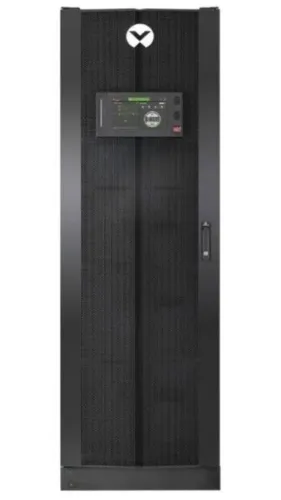

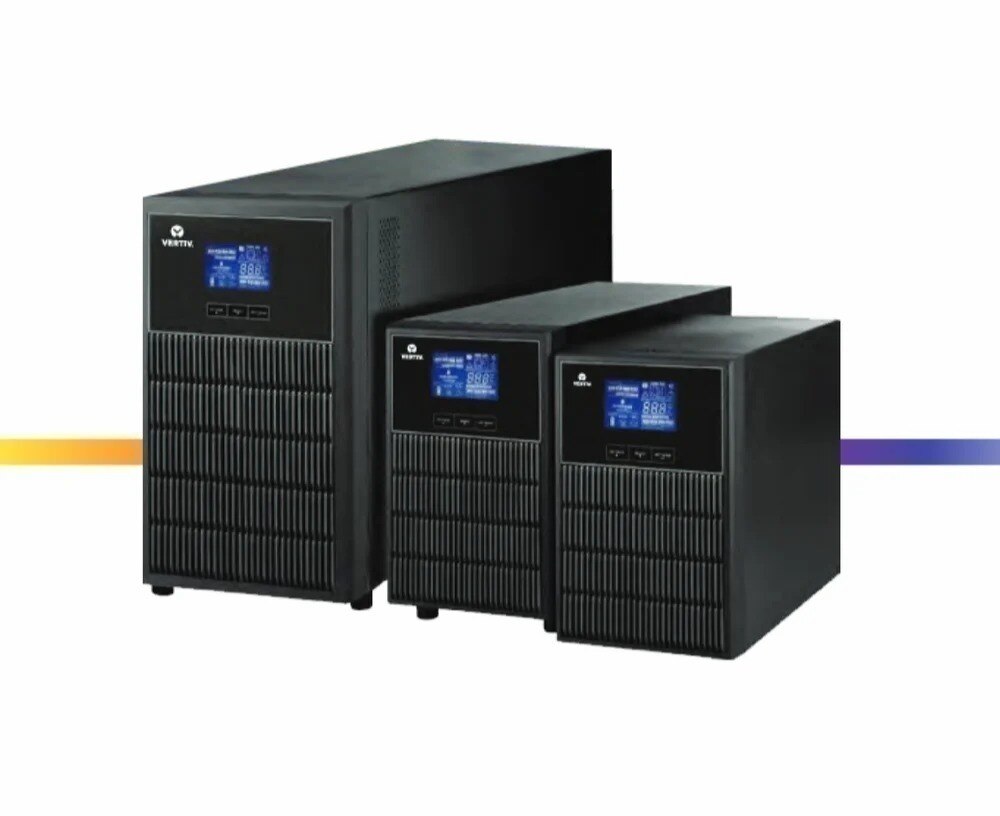
A 1 kVA, 2 kVA or 3 kVA UPS must be matched to real watts, starting current, runtime and site wiring—not selected from the kVA label alone. You will be able to calculate the required capacity, compare the Vertiv Liebert ITA2 variants and prepare a quotation request that exposes battery, connection and installation gaps.
Key takeaways
- Size by watts first; at 0.9 power factor, 3 kVA provides about 2.7 kW.
- Specify required runtime, battery configuration, input plug and output sockets.
- Choose online conversion when voltage quality and zero transfer time matter.
- Compare Pune quotations for batteries, installation, warranty, delivery and commissioning.
How to size an ITA2 UPS from actual equipment load
Choose the UPS by watts first, then check VA, power factor, starting current and growth. At a 0.9 output power factor, the practical ceilings are about 0.9 kW for 1 kVA, 1.8 kW for 2 kVA and 2.7 kW for 3 kVA. A 3 kVA UPS is not a 3 kW UPS.
- Record each device’s measured input watts during normal operation. Include servers, switches, storage, monitors and telecom equipment, then add the readings rather than relying on nameplate VA alone.
- Check the highest startup demand. Contactors, solenoid valves, pumps, compressors, transformers and motor drives can draw several times their running current. Obtain inrush data from the equipment manufacturer and confirm the UPS inverter, bypass and overload response.
- Add capacity for expansion. A 1,500 W rack points toward a 2 kVA unit, but a 25% growth allowance raises the planning load to 1,875 W and points to 3 kVA.
- Confirm the load’s power factor and crest factor. Poor or unknown power factor can consume the UPS watt limit before its kVA rating is reached.
For industrial single phase UPS selection, separate normal overload duration from short-circuit clearing. A brief overload pass does not prove that the inverter can start a pump or clear every downstream breaker fault. Also verify the site’s 230 V-class single-phase input and output, frequency, plugs and receptacles before accepting the kVA choice.
What the Vertiv Liebert ITA2 1, 2 and 3 kVA variants deliver
The 1, 2 and 3 kVA labels do not tell you the usable watt capacity or overload behavior. Compare the base model and suffix, rated watts, selectable voltage, frequency, single-phase arrangement and the manufacturer’s overload-time curve.
| Variant | Rated output | Voltage, frequency and phase | Overload detail to compare |
|---|---|---|---|
| Vertiv Liebert ITA2 1 kVA | 1,000 VA / 900 W | 220/230/240 V class; 50/60 Hz; single-phase input and output | Percentage load, duration before bypass or shutdown, and short-circuit response |
| Vertiv Liebert ITA2 2 kVA | 2,000 VA / 1,800 W | 220/230/240 V class; 50/60 Hz; single-phase input and output | Continuous overload limit, time-rated overload steps, and bypass availability |
| Vertiv Liebert ITA2 3 kVA | 3,000 VA / 2,700 W | 220/230/240 V class; 50/60 Hz; single-phase input and output | Same curve, tested against the connected load’s inrush and crest factor |
For the Vertiv Liebert ITA2 1 kVA UPS in Pune, confirm the exact model suffix, input plug and output sockets rather than assuming compatibility from “230 V.” Apply the same check to the Vertiv Liebert ITA2 2 kVA UPS and Vertiv Liebert ITA2 3 kVA UPS.
A rack can reach the watt limit before its kVA limit when power supplies have poor power factor or high crest factor. Ask for IEC 62040-3 test data, overload percentages and time limits in normal online mode; economy-mode figures alone do not prove equivalent protection.
How to specify runtime, batteries and site connections
A 20-minute requirement at a 600 W load needs 200 Wh of delivered energy before allowing for UPS losses, battery ageing and temperature. Treat that figure as a starting point, not a runtime promise: battery discharge curves, load power factor and end-of-discharge voltage determine the actual result.
Specify the requirement in this order:
1. State the protected load in watts and the required runtime, such as 600 W for 20 minutes, at 50%, 75% or 100% loading. Ask for a manufacturer runtime chart at that exact load, not an unspecified “backup time.”
2. Identify the battery arrangement: internal or external, chemistry, nominal DC voltage, battery count or configuration, and whether additional battery cabinets are included. Request the quoted runtime with and without each cabinet.
3. Record the expected replacement interval and the temperature used for the runtime claim. Aged batteries and a hot battery room reduce available minutes; a larger kVA label does not automatically provide longer backup.
4. Confirm the site connection: single-phase nominal 230 V-class input and output, actual input plug, output sockets or terminal blocks, nominal frequency, permitted voltage range and neutral arrangement. Check upstream protection, earthing, short-circuit coordination and the maintenance-bypass method.
5. Allow rack or tower clearances, front and rear access, cable entry, ventilation space and battery-module weight. A unit can fit electrically yet fail installation review when bypass wiring or battery ventilation has nowhere to go.
When online conversion is worth the cost for a single-phase load
Choose an online double-conversion UPS when a transfer delay, voltage disturbance or frequency variation could disrupt the load. Its rectifier and inverter continuously rebuild the output, so equipment remains powered from the inverter rather than waiting for a standby transfer or correcting input voltage through a line-interactive transformer.
| UPS type | Main advantage | Better fit |
|---|---|---|
| Standby | Lowest complexity and cost | Basic PCs and non-critical peripherals |
| Line-interactive | Voltage regulation with short battery transfer | Office equipment with tolerable switching |
| Online double-conversion | Conditioned output with no normal transfer-time dependency | Servers, storage, network cores and sensitive controls |
The premium is justified when Pune power at the installation has frequent sags, surges, generator transitions or unstable frequency, or when a reboot would corrupt data, stop a process or require a service visit. It is harder to justify for a non-critical workstation that users can restart.
For industrial single phase UPS selection, do not treat “online” as proof that a 1–3 kVA unit can start any machine. Contactors, solenoid valves, pumps, compressors, transformers and drives can demand high inrush current.
Obtain measured or manufacturer-provided starting data, then check inverter overload duration, bypass-transfer conditions and downstream fault current separately; overload capability is not short-circuit-clearing capability.
Ask for efficiency at your actual load and operating mode, including the ITA2 high-efficiency mode. A peak efficiency figure can mislead at light load. Finally, verify the upstream breaker, earthing, neutral arrangement, short-circuit coordination and maintenance-bypass design before ordering.
How to compare a Pune distributor quotation before ordering
Do not accept the quotation until it identifies the exact Vertiv Liebert ITA2 variant and proves that its usable watt output covers your measured load, not merely its kVA label. It must also show what arrives at the Pune site and what happens when battery or input conditions differ.
| Item | Quotation must state | Why it matters |
|---|---|---|
| Unit | Exact 1, 2 or 3 kVA model, rated watts, 230 V-class single-phase input and output, frequency and overload limit | Confirms capacity and site compatibility |
| Battery | Internal or external, chemistry, DC voltage and configuration, replacement interval, runtime at a stated load, and whether extra cabinets are included | “Battery backup included” is not a specification |
| Connections | Input plug, output receptacles, cable requirements and protective breaker | Prevents an installation mismatch |
| Generator | Input-frequency window, rectifier behaviour, harmonic current, generator sizing and response to frequency variation | An online UPS is not automatically generator-compatible |
| Efficiency | Efficiency at your intended load in normal online and high-efficiency modes | Peak efficiency can overstate savings at light loads |
Ask a UPS systems distributor in Pune for the load percentage used in every runtime and efficiency claim. For a rack with high inrush or poor power factor, request the watt and crest-factor assumptions in writing; the 2 kVA or 3 kVA unit can reach its watt limit first.
- substitutes a generic “1–3 kVA UPS” for a model number
- omits the output socket arrangement
- quotes runtime without battery configuration
- gives no generator acceptance data
Originate Power Solutions can clarify these fields by documenting the proposed configuration against your measured load and site supply.
Related product
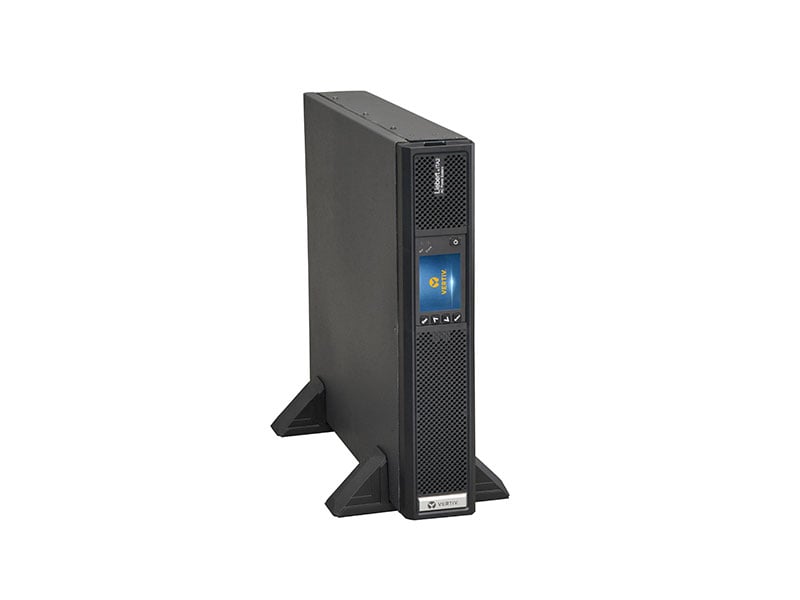 | Single Phase UPS Vertiv Liebert ITA2 UPS 1-3 kVA ₹35144 The Vertiv Liebert ITA2 (1-3 kVA) series is a full-featured transformer-free UPS designed to offer compact, efficient, and reliable power to modern... View product → |
Frequently asked questions
How do you size a Vertiv Liebert ITA2 UPS from actual equipment load?
Add the equipment’s real wattage, check the total VA and power factor, account for starting current, then reserve capacity for growth. At a 0.9 output power factor, practical ceilings are about 0.9 kW for 1 kVA, 1.8 kW for 2 kVA and 2.7 kW for 3 kVA.
What do the Vertiv Liebert ITA2 1, 2 and 3 kVA variants deliver?
The 1 kVA, 2 kVA and 3 kVA variants provide progressively higher load capacity for single-phase applications. Compare each unit’s watt rating, battery arrangement, runtime options, input and output connections, physical dimensions and expansion requirements.
How should you specify runtime, batteries and site connections?
State the protected load in watts, required runtime in minutes, battery type and quantity, recharge expectations, input voltage, plug rating, output sockets and earthing arrangement. Confirm whether the quoted runtime uses internal batteries or an external battery cabinet.
When is online conversion worth the cost for a single-phase load?
Online double-conversion is worth considering when equipment needs continuous voltage and frequency conditioning, zero transfer time, or protection from unstable utility power. A lower-cost topology can suit noncritical loads with stable power and tolerance for transfer time.
How do you compare a Pune distributor quotation before ordering?
Check the exact ITA2 model and watt rating, battery scope, promised runtime, delivery date, installation, commissioning, warranty, taxes, transport, service response and replacement-battery terms. Ask for a line-item quotation rather than comparing only the UPS purchase price.