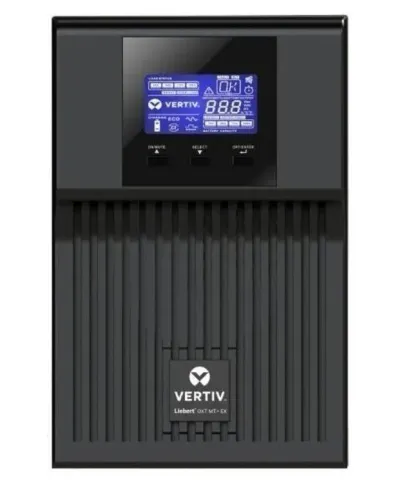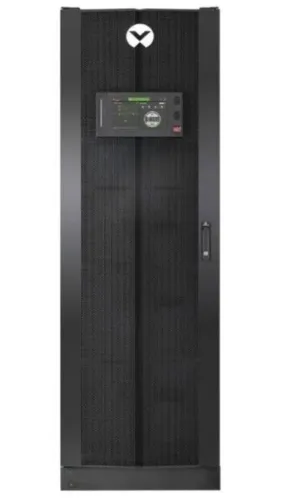

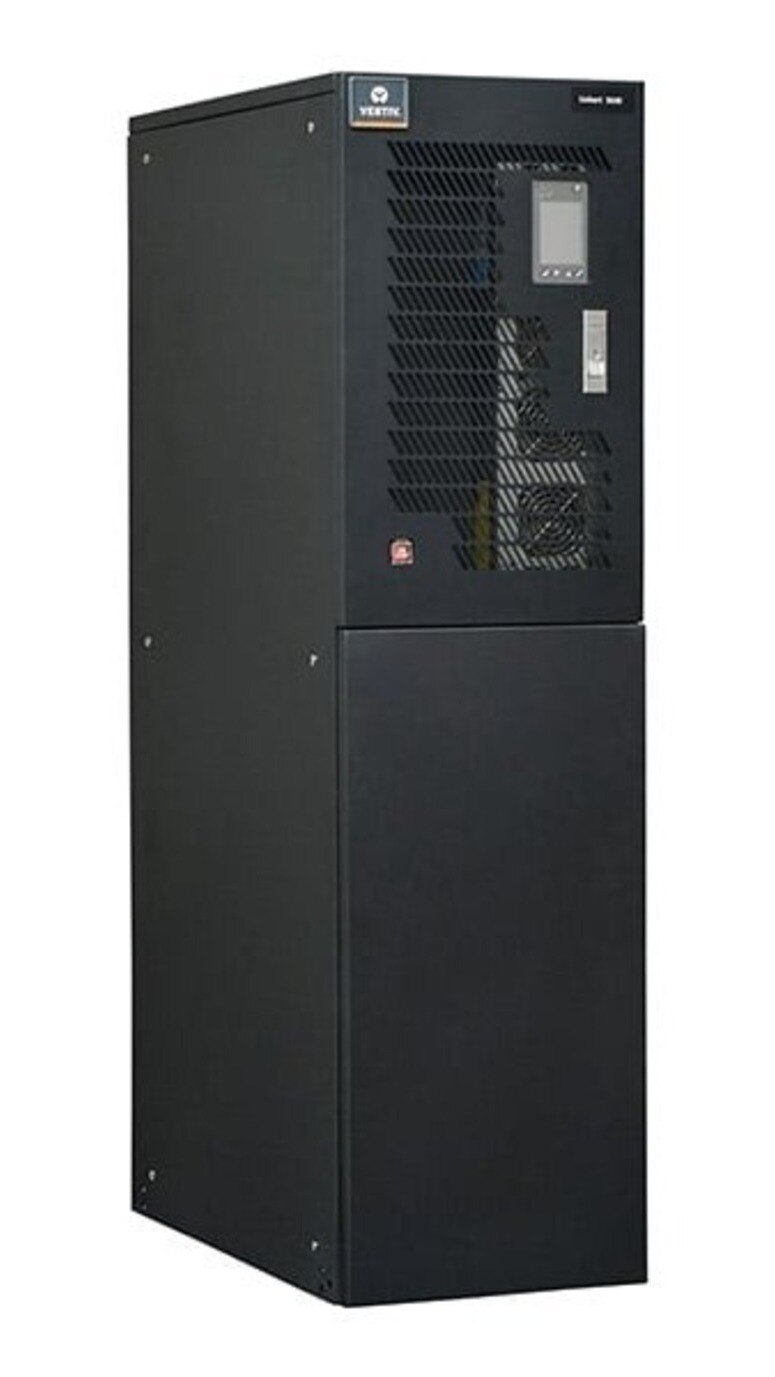
A Vertiv Liebert EXM2 is not simply a box rated at 100, 120, or 150 kW: it is one part of an electrical system that includes the utility or generator, distribution boards, bypass path, batteries, and critical load. By the end, you can translate the rating into usable capacity, estimate backup requirements, identify installation checks, and compare quotations from Pune suppliers on engineering terms rather than price alone.
Key takeaways
- Choose 100 kW, 120 kW, or 150 kW from measured load and growth margin.
- Separate battery capacity from the backup runtime your facility actually needs.
- Confirm bypass, generator, cabling, earthing, testing, and commissioning in writing.
- Compare quotations by included scope, not UPS cabinet price alone.
How the EXM2 processes power for a Pune facility
The Vertiv Liebert EXM 2 takes three-phase incoming AC power, converts it to DC through a rectifier, then converts that DC back into regulated AC through an inverter. The inverter supplies the critical load continuously, while the battery connects to the DC bus and supports it when the input fails.
This transformer-free, online double-conversion path isolates servers, medical equipment, control systems, and other Pune facility loads from voltage dips, frequency variation, and many input disturbances.
For a 100–150 kW installation, confirm the exact EXM2 model and its kVA rating. A unity-power-factor model rated at 100 kVA can deliver 100 kW of real load, subject to its operating limits; a site load stated only as kVA needs its power factor before you compare capacities. The bypass is a separate supply path.
The static bypass can feed the load during an overload, inverter fault, or controlled transfer, but the load then depends on bypass quality rather than inverter conditioning.
| Mode | What happens between supply and load | Practical consequence |
|---|---|---|
| Online double conversion | Rectifier and inverter remain in the power path | Best protection; continuous conversion losses apply |
| ECO mode | Bypass normally feeds the load; inverter stands ready | Higher efficiency, but bypass disturbances and transfer time matter |
| Active ECO mode | Bypass normally carries the load while the inverter remains active for faster correction or transfer | Efficiency improves, but bypass dependence remains |
Do not select ECO or Active ECO solely for its efficiency figure. Make that choice in the facility’s operating policy.
How to choose between 100 kW, 120 kW, and 150 kW
Start with measured real power, not the service rating. Add the critical loads in kW, then include planned growth and a design margin. If the load is stated in kVA, convert it using kW = kVA × power factor; a 125 kVA load at 0.9 power factor equals 112.5 kW.
| Choice | Maximum design load | Growth and redundancy implication |
|---|---|---|
| 100 kW | Up to 100 kW of continuous critical load | Fits only when measured load plus growth remains below 100 kW |
| 120 kW | Up to 120 kW of continuous critical load | Provides 20 kW more headroom than the 100 kW option |
| 150 kW | Up to 150 kW of continuous critical load | Provides the largest single-unit reserve, but not redundancy by itself |
Do not select 150 kW simply because the site may expand. Compare the present load, target load, motor-starting behaviour, harmonic profile, and the manufacturer’s permitted loading for the exact Vertiv Liebert EXM 2 model.
Keep enough spare capacity for the planned growth period; otherwise a new UPS or parallel expansion arrives before the electrical room is ready.
For resilience, ask three phase UPS dealers in Pune to show the single-line diagram and state whether the proposal is capacity-only, capacity-plus-capacity, or true N+1. Confirm the permitted number of parallel units, parallel cards, system controls, and bypass rating.
Two 100 kW units can provide N+1 for a 100 kW design load; one 150 kW unit cannot. Require the quotation to state 400/415 V, 50 Hz, phase arrangement, neutral requirement, and exact kW/kVA rating.
Battery sizing: capacity is not the same as backup time
A 100 kW UPS does not provide 100 kW of battery backup. Runtime depends on the actual load in kW, battery chemistry, number of blocks or strings, end-of-discharge voltage, battery age, temperature, and recharge settings. Require a runtime table at today’s load and the planned future load, not a single “battery backup” figure.
Specify these battery requirements separately from the EXM2 power rating:
- Battery type: VRLA or lithium-ion; include the manufacturer, model, nominal voltage, capacity, and discharge-rate basis.
- Autonomy: state the required minutes at the present and target design loads, including the permitted end-of-discharge voltage.
- Recharge: state the maximum acceptable recharge time, charger current, and whether the generator can support the UPS and recharge load together.
- Monitoring: require string current, individual block voltage and temperature, cabinet temperature, state-of-charge reporting, and alarm contacts or network integration.
- Room: confirm ambient temperature, ventilation, humidity, clearances, floor loading, access, and fire-safety provisions against the exact installation manual. Keeping batteries near the reference temperature, commonly 25 °C, protects service life.
The phrase exm 2 online ups in pune is an application search, not a specification. Include site voltage, connected kW, growth load, autonomy, battery type, room temperature, generator, and bypass arrangement in every enquiry. Check whether battery cabinets, racks, DC cables, breakers, and commissioning are included; omissions can change the installed cost substantially.
Electrical, generator, bypass, and acceptance checks
Before connecting an EXM2, confirm that the Pune site matches the ordered electrical configuration: 400/415 V, 50 Hz, three-phase input and output, neutral requirement, and the permitted voltage range. Check ambient temperature, ventilation, floor loading and altitude against the exact installation manual; keep battery spaces near the manufacturer’s reference temperature, commonly 25 °C.
- Verify phase rotation, earthing, conductor sizes, protective-device ratings, short-circuit capacity and separation between normal, bypass and maintenance-bypass supplies.
- Match the generator’s kVA, alternator sub-transient reactance and step-load response to the UPS. Confirm rectifier walk-in or soft-start, input power-factor correction and permissible input-current distortion.
- Prove that the static bypass and maintenance bypass have the correct phase sequence, voltage and interlocking. A bypass mismatch can place the load across an incompatible source.
- Record input and output voltage, frequency, current, phase balance, power factor and harmonic readings at no load and operating load.
- Test rectifier and inverter startup, transfer to bypass, return from bypass, overload response and operation of the maintenance bypass.
- Perform the specified battery autonomy or discharge test; a factory certificate does not prove performance on this electrical system.
- Test every alarm, dry contact, emergency stop, battery alarm and communications connection with the building-management or monitoring system.
| Test | Acceptance evidence | Failure consequence |
|---|---|---|
| Phase rotation | Correct sequence at input, output and bypass | Reverse rotation or failed transfer |
| Generator run | Stable voltage and frequency during load step | Nuisance transfer or generator instability |
| Alarms and communications | Events appear at the designated monitoring point | Faults remain unseen |
A search for “three phase ups distributor in pune” identifies location, not commissioning capability; require trained startup personnel and model-specific warranty support in the purchase order.
How to compare Pune EXM2 quotations without missing scope
A complete enquiry lets every bidder price the same system. State the exact EXM2 kVA model, 400/415 V nominal supply, 50 Hz frequency, three-phase input and output, neutral arrangement, acceptable input-voltage range, and the installation location.
- Connected load in kW and kVA, measured peak demand, power factor, present load, and target growth load
- Required autonomy in minutes at both present and future design loads
- Battery chemistry, number of blocks or strings, end-of-discharge voltage, recharge time, monitoring, racks, cabling, and room temperature
- Generator rating and compatibility, upstream breaker and trip curve, maintenance-bypass arrangement, earthing, and downstream selective coordination
- Delivery, installation, commissioning, operator training, warranty, preventive maintenance, and emergency response times
Use this comparison when quotations arrive:
| Quotation detail | Accept only when | Why it matters |
|---|---|---|
| UPS price | Exact kVA model, configuration, options, taxes, freight, and installation are separated | “EXM2” alone does not identify capacity or scope |
| Battery offer | Runtime tables show actual and future kW loads, battery age assumptions, and temperature | Battery backup changes with load, chemistry, and temperature |
| Electrical scope | A single-line diagram identifies breakers, bypass interlocks, neutral, earthing, and fault levels | A low kVA price can exclude essential protection |
Location does not prove authorization. Ask three phase ups dealers in pune for current Vertiv channel status, model-specific supply authority, serial-number warranty registration, Pune service escalation, named response times, and trained startup personnel in the purchase order. Ask Originate Power Solutions to document the same evidence before comparing its quote.
Related product
 | Three Phase UPS C. Vertiv™ Liebert® EXM 2 UPS (100-150 kW) -Transformer-Free Design Vertiv™ Liebert® EXM2 is a monolithic UPS designed to address the rising need of highly reliable and efficient UPS for next-gen mid-size critical... View product → |
Frequently asked questions
How does the Vertiv Liebert EXM 2 process power for a Pune facility?
The rectifier converts incoming three-phase AC to DC, and the inverter converts the DC bus back to regulated AC for the critical load. The battery supports the DC bus when the input supply fails.
How do you choose between a 100 kW, 120 kW, and 150 kW EXM 2?
Start with the measured critical load, then account for planned growth, redundancy requirements, power factor, and the operating margin required by your facility.
Does UPS battery capacity equal backup time?
No. Backup time depends on the battery system’s usable energy, discharge rate, battery condition, UPS efficiency, and connected load. Request a runtime calculation at your actual load.
What checks should Pune buyers complete before accepting an EXM 2 installation?
Check incoming and bypass supplies, cable sizing, earthing, generator compatibility, battery connections, alarms, transfer operation, load-bank results, and commissioning records.
How should you compare quotations from three-phase UPS dealers in Pune?
Compare the UPS rating and configuration alongside batteries, autonomy, bypass equipment, installation, cabling, protection, testing, commissioning, warranty, and exclusions.